
Alamosa County Criminal Court Records
Criminal court records in Alamosa County are maintained through the Colorado Judicial Branch at Alamosa Combined Court. The combined court serves both Alamosa District Court and Alamosa County Court, so one public counter and one state court location handle many criminal case tasks. District court hears felony criminal cases. County court handles misdemeanors, traffic infractions, protection orders, and felony complaints that may later move to district court. That split matters when reading a criminal docket because early advisement or bond activity may appear before the final felony case is tracked in district court.
The criminal case file is broader than the first charge. It may include the complaint or information, advisement entries, bond hearing notes, arraignment, motions, plea entries, trial settings, restitution, probation terms, disposition or sentence orders, and related protection orders. The charge detail itself is covered more closely in the Alamosa County arrest records and charges material, while this criminal court record is the case-level history that shows how the court handled the prosecution from opening through final outcome.
The Colorado Judicial Branch lists Alamosa Combined Court at 8955 Independence Way, Alamosa, CO 81101. The court phone is 719-589-4996 and the public email is alamosaclerk@judicial.state.co.us. Public hours are Monday through Friday, 8:00 a.m. to 5:00 p.m., except state holidays.
Search Alamosa County Criminal Cases
Alamosa County does not run a separate county clerk criminal database. Public criminal court lookup starts with the Colorado Judicial Branch docket search, which can be filtered to Alamosa County. The docket search is useful for hearing dates, case numbers, party names, court type, courtroom, and hearing labels such as arraignment, first hearing, pretrial conference, status conference, appearance on bond, or appearance of counsel. It is not a full document database.
- Open the Colorado Judicial Branch docket search and choose Alamosa County or Alamosa Combined Court as the location filter.
- Use at least one filter in addition to date, such as party name, business name, attorney name, attorney bar number, or case number.
- Set court type to District, County, or Both, depending on whether the matter is likely a felony, misdemeanor, or early felony complaint.
- Review the case number, hearing type, date, time, location, courtroom, and visible party name in the result list.
- Use the Colorado Judicial Branch record/document request form for Complaint/Information, Disposition/Sentence Order, Protection Order, Ticket, ROA, certified copies, or exemplified copies.
The court form asks for requestor contact details, case number if known, case type, filing year, county or location, date of birth if known, party information, and the document category requested. Criminal matter checkboxes include Complaint/Information, Disposition/Sentence Order, Protection Order, and Ticket. A separate statewide criminal history arrest record check is through CBI, not the Alamosa court clerk.
Alamosa Criminal Case Flow
A criminal case record grows as the case moves. In Alamosa County, a person may first appear in county court for advisement or bond. A felony can later proceed in district court if the case is filed or bound over. Misdemeanors commonly remain in county court. The docket may show early events before it shows final disposition, so the current status should be read against the latest hearing or order.
Case flow: Charges Filed › Advisement or Arraignment › Pretrial and Motions › Plea or Trial › Disposition › Sentencing.
| Stage | What the Alamosa County record may show |
|---|---|
| Charges filed | Complaint, information, ticket, or felony filing tied to a court case number. |
| Advisement or arraignment | Early hearing where rights, bond, charges, and plea timing may be addressed. |
| Pretrial and motions | Status conferences, evidence motions, continuances, appearances of counsel, and bond review events. |
| Plea or trial | Guilty plea, not guilty plea, trial setting, verdict, acquittal, deferred judgment, or dismissal path. |
| Disposition and sentencing | Final charge outcome, sentence, probation, restitution, costs, or other court-ordered terms. |
Note: A felony complaint in county court is not always the final felony case file, so check the latest court type and case number.
Alamosa Criminal Record Fields
A docket result is a pointer to the court file. The record request form is the channel for actual documents. The public docket result fields observed for Alamosa include date, time, duration, party name, case number, hearing type, location, appearance type, and courtroom. Case numbers may use a four-digit year plus class letters and sequence, with examples such as CR for criminal, M for misdemeanor or county criminal, T for traffic, JV for juvenile, and PR for probate. Local use should be confirmed from the actual record.
| Field | What it shows |
|---|---|
| Case number | Year, class letters, and sequence used to identify the Alamosa County criminal case. |
| Defendant name | The person charged in the case, often displayed in last-name-first format on docket results. |
| Charge document | Complaint, information, ticket, or other filing that starts or defines the criminal accusation. |
| Hearing type | Arraignment, first hearing, pretrial conference, status conference, bond appearance, or similar event. |
| Disposition | The outcome of a charge or case, such as guilty plea, dismissal, acquittal, or deferred judgment. |
| Sentence | Punishment or conditions after conviction, such as probation, restitution, costs, jail, or other terms. |
| ROA | The register of actions, a chronological summary of filings, hearings, minute orders, charges, and sentences. |
The 12th Judicial District Attorney posts local prosecution context through its official site. The 12th Judicial District Attorney serves Alamosa, Conejos, Costilla, Mineral, Rio Grande, and Saguache counties and identifies Anne E. Kelly as District Attorney.
The image below comes from the 12th Judicial District Attorney official homepage, one of the local sources for prosecution contact and district coverage.
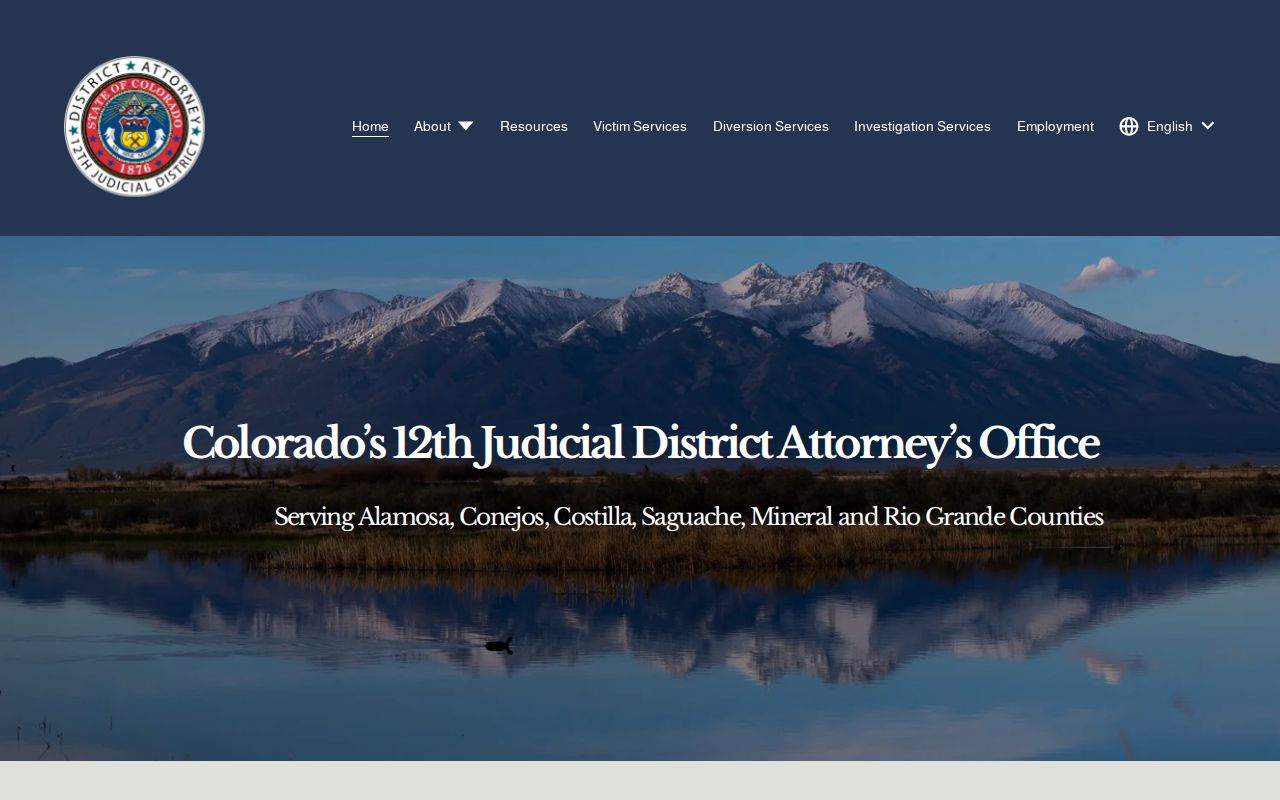
The DA source is useful because it separates the prosecutor's charging role from the court clerk's role in maintaining the final criminal case record.
Alamosa Charges and Convictions
A charge is an accusation filed or pursued in the criminal process. A conviction is a final finding or plea of guilt. Alamosa County criminal court records may show charges that were amended, reduced, dismissed, deferred, or resolved by plea. That is why the disposition or sentence order is often more important than the first charge line for record review.
| Point | Charge | Conviction |
|---|---|---|
| Meaning | An accusation or filed count in a criminal matter. | A final guilty plea or finding after court action. |
| Where it appears | Complaint, information, ticket, docket, or ROA. | Disposition order, sentence order, ROA, and final docket entries. |
| Can change | May be amended, reduced, added, or dismissed. | Usually changes only through appeal, post-conviction action, or sealing order. |
| Reader risk | Should not be treated as proof of guilt. | Still must be read with sentence, probation, and sealing status. |
For a person in custody before final case resolution, jail information and criminal case information may not match perfectly. Custody status belongs with the sheriff and jail. Court outcome belongs with the clerk's criminal case file. A person may be released while a case remains open, or a case may continue after the original arrest charge has changed.
Public Defender Records Context
The Colorado State Public Defender Alamosa office is a related source for criminal case process, though it is not the custodian of public criminal court records. The office serves Alamosa, Conejos, Costilla, Mineral, Rio Grande, and Saguache counties. Its page lists the office at 610 Main St., Alamosa, CO 81101, phone 719-589-9615, fax 719-589-6178, and email Alamosa@coloradodefenders.us. The office head is Jamie Keairns and the office manager is Angelica Hart.
The Colorado State Public Defender Alamosa office page is shown in the source image below.
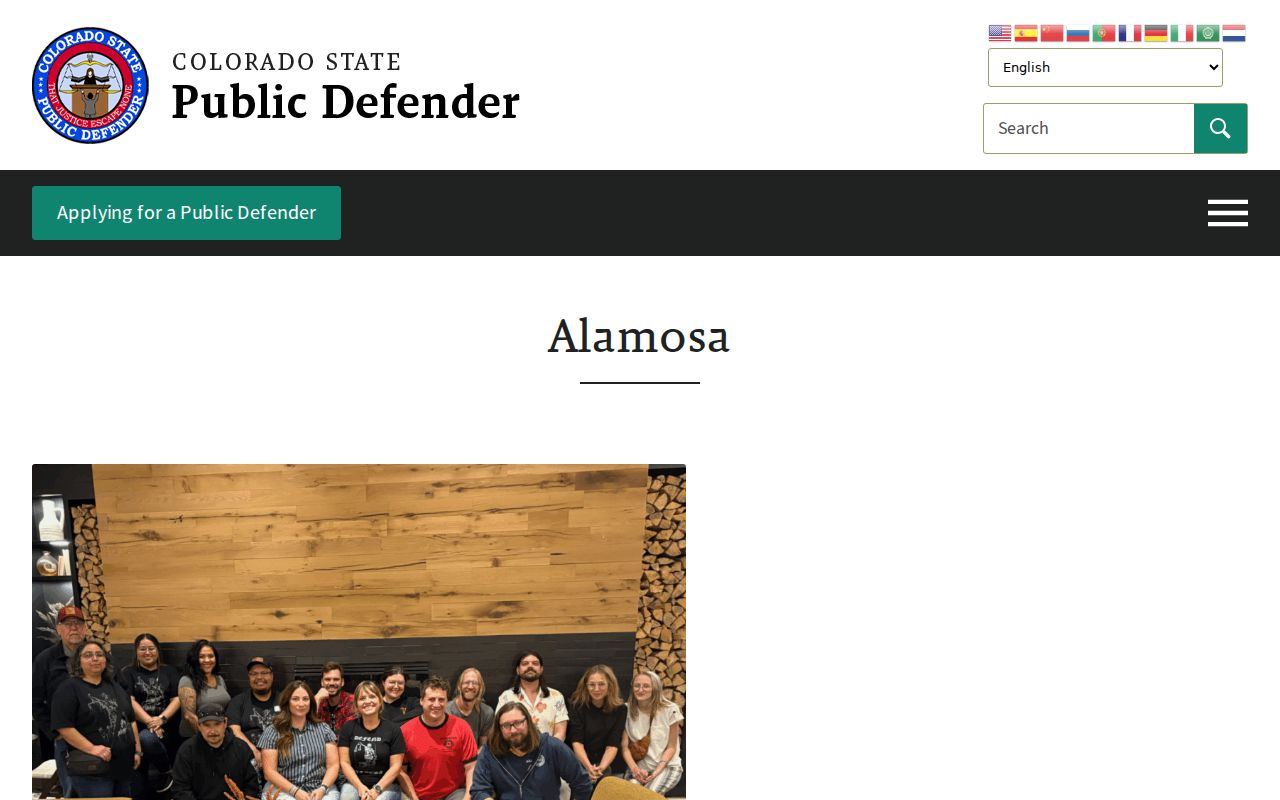
Defense office information can help identify representation channels, but certified criminal court records still come from the court clerk or official record request form.
The Colorado Public Defender application process explains that out-of-custody adults use the state paid professional application and juvenile applications involve a parent, guardian, or legal custodian.
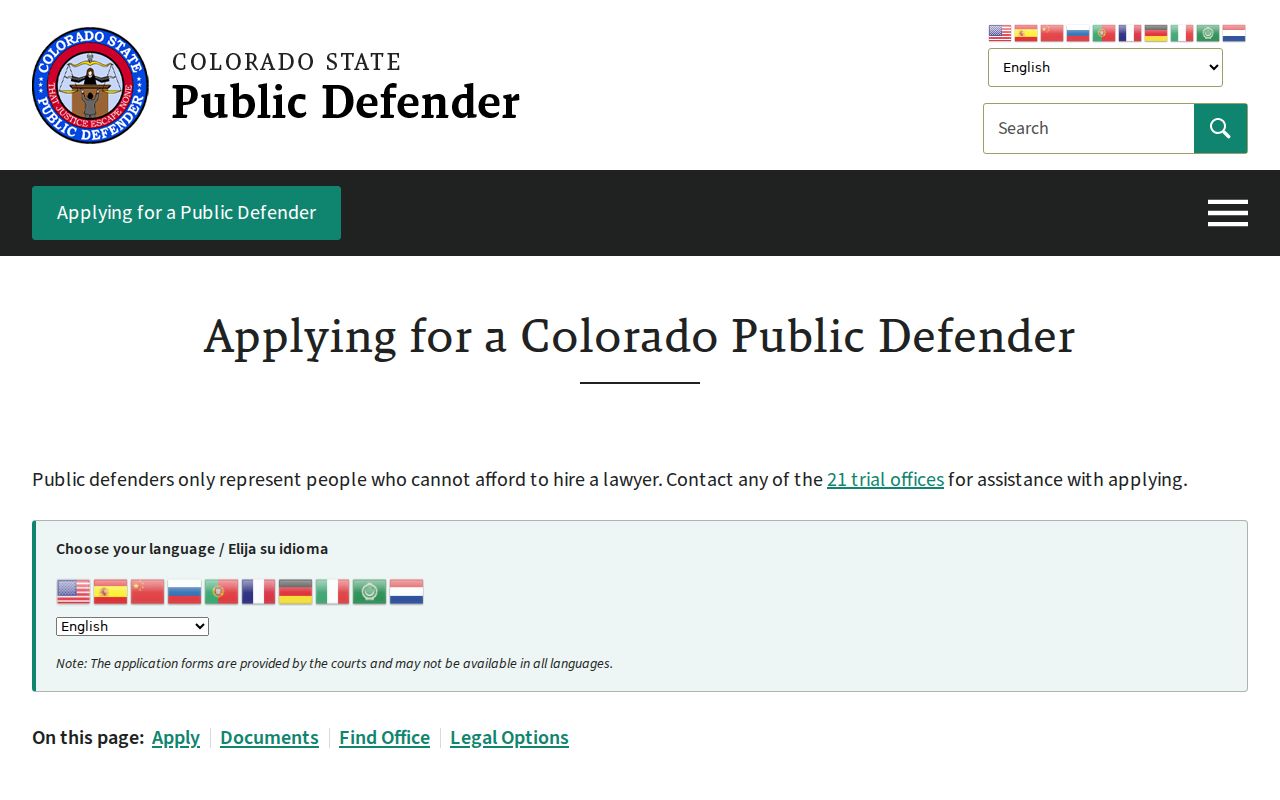
This application source matters because a criminal record may show appearance of counsel even when the public docket does not show attorney details in the result list.
Sealed Alamosa Criminal Records
Some Alamosa County criminal records are public, but not all criminal material is open. The state record request form says access can be restricted under Colorado statutes, court rules, Supreme Court rules, Chief Justice Directives, local orders, and other authority. Suppressed cases, juvenile records, probate records with protected information, and documents with confidential data may require U.S. government-issued photo ID or may not be released to the public.
| Point | Sealed | Expunged |
|---|---|---|
| Public view | Restricted from ordinary public access after a court order or qualifying process. | Removed, destroyed, or specially treated under a narrower legal category. |
| Common use | Adult criminal cases that meet Colorado eligibility rules and waiting periods. | Often tied to juvenile or specific statutory categories. |
| Agency access | Criminal justice agencies may retain authorized access. | Access is more limited and depends on the governing statute. |
| Alamosa step | Identify the case number and disposition, then file in the court that handled the case. | Use the Colorado form and statute that match the record type. |
Colorado's Legislative Council identifies C.R.S. 24-72-706 as a central conviction-sealing provision. Some convictions are not eligible, including traffic offenses, traffic infractions, and DUI categories. Juvenile records are governed by Colorado Title 19, which means juvenile criminal information should not be treated like ordinary adult public court records.
Public Access to Alamosa Criminal Records
Alamosa County criminal court files are state judiciary records. The Colorado court records access policy summary references Chief Justice Directive 05-01 as the public access framework for court records. County administrative and sheriff records use a different path under CORA or CCJRA. The Colorado Open Records Act covers many government public records, while criminal justice agency records are handled under the Colorado Criminal Justice Records Act.
Access rule: Dockets can identify hearings and case numbers, but certified copies, sentence orders, and protected documents require an official court request.
Fees depend on the record type. The research file lists court copy fees of $0.25 per page, $20.00 for certified or exemplified copies per document, $5.00 for a court name search, $25.00 for a transcript of judgment, and $30.00 per hour for court research or redaction after the first hour in 15-minute increments. The current court form or clerk should be used before payment because fee schedules can change.
Note: Do not use criminal court records for employment, housing, credit, insurance, or similar screening unless the process complies with the FCRA and all other law.